
What Are the Different Types of Glass in a Window, and What Do They Actually Do?
Glass looks like a single material, but the glass in a modern window is closer to a specification than a single product. Toughened, laminated, low-E, acoustic, low iron, solar control – each does something different, and a single sealed unit can carry more than one of them at once. Understanding what each type actually does makes it far easier to have a useful conversation about your own windows, rather than simply trusting a spec sheet.
Glass has faces – and it matters which one a coating is applied to
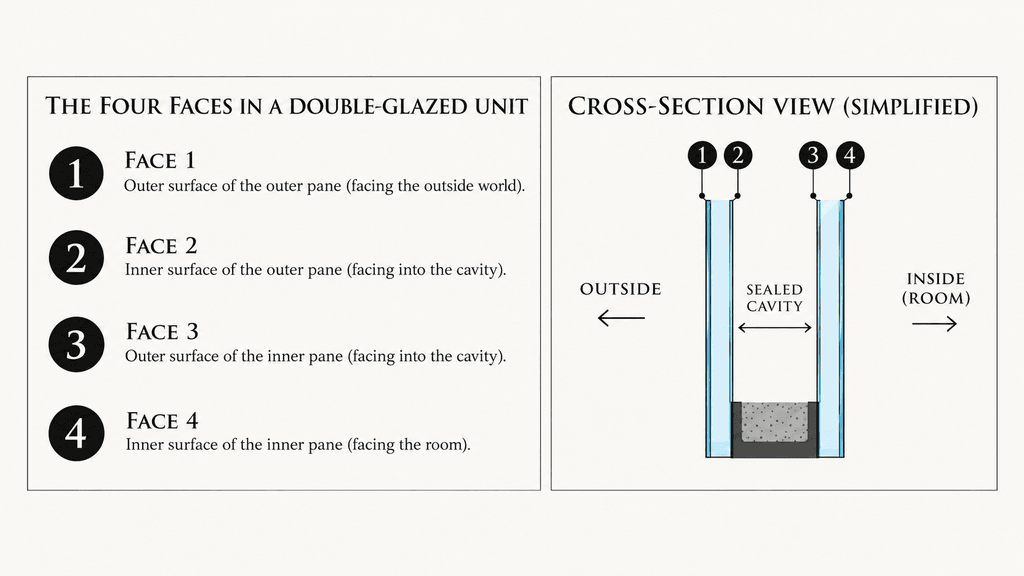
Before getting into the different types, it helps to understand a detail most people never come across: every pane of glass in a sealed unit has two sides, or “faces,” and manufacturers number them.
In a standard double-glazed unit, there are four faces in total. Face 1 is the outermost surface, facing the outside world. Face 2 is the inner surface of that same outer pane, facing into the sealed cavity. Face 3 is the surface of the inner pane, also facing into the cavity. Face 4 is the surface facing into the room. Triple glazing simply extends the same logic across three panes, giving six faces in total.
This matters because coatings are applied to specific faces on purpose, not at random. A low-E coating, for example, is typically applied to Face 3 – protected inside the sealed cavity, but positioned to reflect the room’s own heat back inwards rather than letting it escape outward. A solar control coating usually goes on Face 2, so that unwanted solar heat is reflected before it ever reaches the cavity. It’s entirely possible for a single unit to carry two different coatings on two different faces, each doing a different job, without one interfering with the other.
Toughened glass
Toughened glass – also known as tempered – starts life as ordinary float glass. This is the standard flat glass made by floating molten glass across a bed of molten tin, which is how almost all window glass is produced. To make it toughened, that float glass is heated to over 600°C and then rapidly cooled. That process puts the surface under compression and the core under tension, which makes the finished pane around four to five times stronger than standard glass of the same thickness.
The real benefit shows up if it ever breaks. Rather than fracturing into long, sharp shards, toughened glass crumbles into small, blunt granules – the same principle behind a car’s side windows. It’s this safe-breakage behaviour, governed by BS EN 12150, that makes toughened glass one of the two standard routes to meeting UK safety glazing requirements (the other being laminated glass, below). Once toughened, a pane can’t be cut, drilled or resized, so it has to be made to the exact measurements from the outset.
Laminated glass
Laminated glass is built from two or more panes bonded together with a tough plastic interlayer, usually PVB, under heat and pressure. Where toughened glass is designed to break safely, laminated glass is designed to barely break at all: if it’s struck hard enough to crack, the interlayer holds the fragments in place rather than letting them fall away.
That makes it a different tool from toughened glass rather than an alternative version of it. The interlayer is a real barrier against forced entry, since an intruder has to cut or punch through it rather than simply crack the glass and reach through. It also blocks a significant amount of UV radiation, which helps furnishings and flooring fade more slowly, and it’s the standard choice for overhead glazing such as roof lights and glazed canopies, where you want any broken glass to stay exactly where it is.
Low-E glass, and Low-E Plus
Low-E stands for low emissivity. It’s a near-invisible metal-oxide coating that lets short-wave solar heat and light pass through freely, while reflecting the long-wave heat radiating from a warm room back inwards, rather than letting it escape through the glass. It’s the single biggest reason modern double glazing performs so much better than the windows it replaced.
Low-E Plus isn’t a single, universally defined standard the way low-E itself is – it’s a term used by some manufacturers and suppliers for an enhanced, higher-performance soft-coat low-E product, generally offering better insulation and a clearer, less tinted appearance than a basic low-E coating. If you see it quoted on a spec, it’s worth asking exactly what it means for that particular supplier, since the name isn’t applied consistently across the industry.
Solar control glass
Solar control glass works on a similar principle to low-E, but in the opposite direction: rather than keeping heat in, it’s designed to keep unwanted heat out. A reflective coating, usually applied to Face 2, rejects a proportion of incoming solar energy before it can enter the cavity and the room beyond. Performance is measured by g-value, or solar factor – the percentage of solar energy that ends up as heat inside the building. The lower the g-value, the more heat is rejected.
It’s particularly useful on large glazed areas, south-facing elevations, and conservatories or orangeries, where a lot of unshaded glass can otherwise turn a room into a greenhouse on a sunny day.
Acoustic glass
Acoustic glass is usually a form of laminated glass, but built with a softer, thicker acoustic-grade interlayer specifically formulated to damp the vibration that carries sound through glass. Many acoustic units also pair two panes of different thicknesses either side of the cavity, rather than matching them – a deliberate piece of design that disrupts the resonance effect you get when sound passes easily between two identical panes.
It’s a popular specification for homes near busy roads, flight paths or railway lines, where the difference between standard and acoustic glazing can be very noticeable in everyday life.
Low iron glass
Standard float glass contains a small amount of iron oxide from the raw sand it’s made from, which gives it a faint green tint – most visible on the edges of a pane, in thicker glass, or when you’re looking through several panes at once, as in triple glazing. Low iron glass, sometimes called extra clear glass, is manufactured with far less iron oxide, removing almost all of that green cast in favour of a clearer appearance.
It’s a popular choice where true colour matters: a picture window looking out over a garden, a glass balustrade, or simply a home where you’d rather see the view as it actually looks, rather than through a faint green filter.
Critical locations: where the law requires safety glass
“Safety glass” isn’t really a separate product – it’s the regulatory term for using toughened or laminated glass in the specific spots where UK Building Regulations require it, known as critical locations. Broadly, that means glazing below 800mm from floor level in windows, glazing below 1500mm from floor level in and around doors, and any glazing within 300mm of a door edge below that same 1500mm height. In practice, this covers low-level windows, full-height glazed doors, and the narrow side panels often fitted alongside a front or patio door.
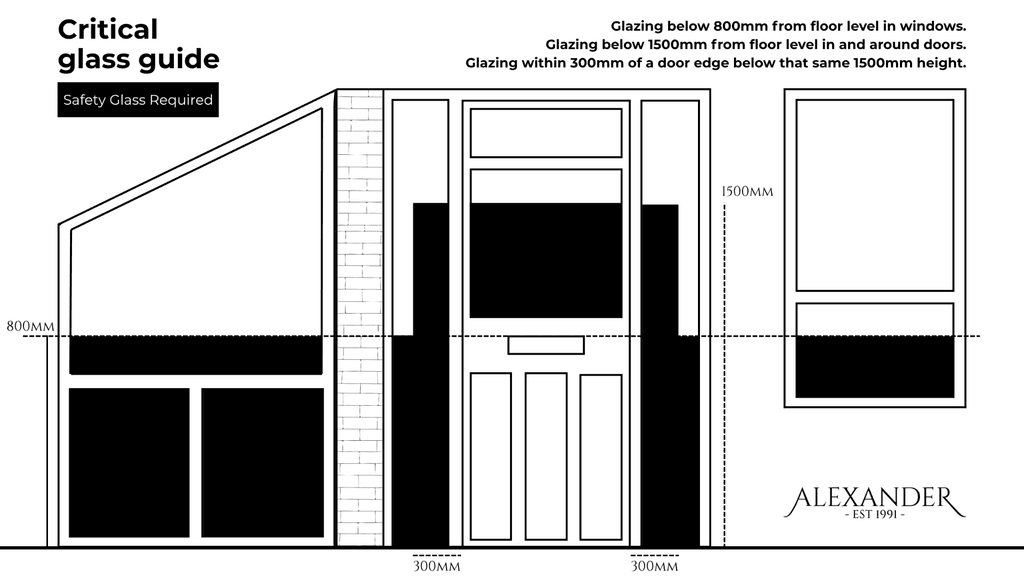
Because both toughened and laminated glass satisfy the safety requirement on their own, a sealed unit in a critical location doesn’t have to use the same type on both panes. Toughened glass on both panes is the most common approach, and it’s typically the most cost-effective. Laminated glass on the outer pane with toughened on the inner is also a valid, commonly specified combination. Laminated on both panes is used less often, but it does come up where a little extra acoustic performance matters, since laminated glass’s interlayer gives it a modest edge over toughened glass at damping sound of a similar thickness.
Most windows don’t use just one type of glass. They use a mix, picked for where the window is and what it needs to do. That might be safety glass in a door, low-E glass to keep the heat in, or acoustic glass for a bedroom facing a busy road. Once you know what each type does, it’s easier to ask the right questions and compare quotes fairly. If you’re not sure what’s right for your home, our team is always happy to help.