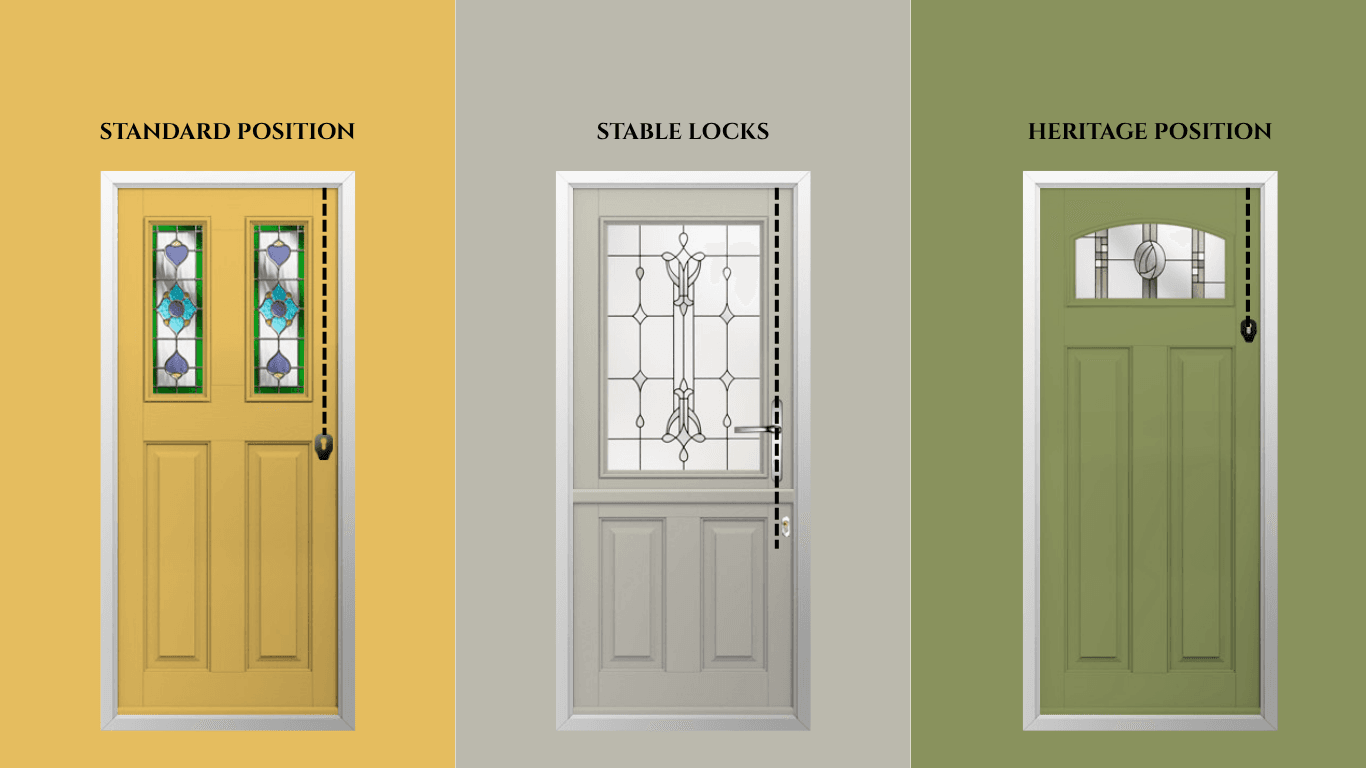
How does the standard door lock position differ from the heritage door lock position?
Composite door locks vary not only in the way they operate but also in the position where they are fitted on the door. The height of the lock – about at the middle of the door or at shoulder level – has just as much effect on the appearance of the door as it does on its use, which is why it’s important to consider both types before making your choice. Since we install both Rockdoor and Solidor composite doors and both manufacturers provide standard and heritage lock positions, the decision comes down to what is appropriate for your particular door rather than which brand you select.
Standard position
The arrangement that the majority of people are familiar with has the key cylinder positioned about halfway up the door, aligned with the handle. You then have the option of how the lock functions. With a lever lock, which is the conventional choice, raising the handle causes the hooks and bolts to move into the frame, and turning the key locks them in place. The slam-shut lock, which is at times marketed as AV2, achieves the same result automatically: the hooks engage as soon as the door is pushed completely shut, without the need to lift the handle, and the lock is then secured by turning the key or using the inside thumb-turn. In both cases, the cylinder remains in the position that is normal, in the centre of the door, and a central latch holds the door shut between the locking positions.
Heritage position
The cylinder of a heritage lock is raised to shoulder height, giving it the appearance of an old-style rim lock rather than that of a modern multi-point cylinder. It is always a slam-shut type of mechanism: when the door is closed, the lock engages automatically because of a magnet in the mechanism which sets the hooks in motion, not because of an electric or powered part, the action being entirely mechanical once the door has been fully closed. You then turn the key or the internal thumb-turn to deadbolt it. The hooks and gearbox remain in their central position and extend the full height of the door as they normally do, so raising the cylinder is merely a matter of style and not a compromise in terms of security. This positioning is one that is most closely associated with period and character doors, since the raised cylinder and finger-pull match well with the traditional features of such doors. On a Rockdoor the model is known as Heritage Plus and Solidor also have their own version.
Stable door locks
Stable doors belong to a separate category because the door is divided into two sections which open independently and the position of the handle also changes with this division. Only the upper part has a handle and it functions like a conventional lever lock: you lift the handle to release the hooks and then turn the key to lock it dead. The lower section has no handle at all and since there’s nothing to lift, it is locked and unlocked by turning the key in its individual cylinder, just as a keywind lock does. Both cylinders accept the same key so you never need to carry two, and a slide bolt connects the two sections together. When the slide bolt is pushed into place the door locks as a single solid unit; when it is pulled out you can open just the top half while the bottom remains shut and locked, which is the usual arrangement for a stable door. We have installed this exact configuration on a stable door in Wilmslow.
Choosing between them
If you’re interested in the appearance and feel of the multi-point locks that you’re already used to, then the standard position is the one to go for, and at the same time you can choose between a lever and a slam-shut version depending on whether you prefer to lift the handle or have the door lock as it closes. When your door has a period or cottage-style character, the heritage position will give it that traditional look without losing any of the locking points underneath. And in the case of a stable door, the top and bottom locks operate independently of your choice of standard or heritage position, which means you have the flexibility to open just the upper half whenever you need to.
Since not all door types offer every possible handle and lock combination, it’s a good idea to check which combinations your chosen door is compatible with before making your final choice. Regardless of which option you prefer, you should see them in person. Our showroom is open 6 days a week, where we display the standard and heritage positioning side by side among our range of Rockdoor and Solidor doors.